Thursday, 15 September 2011

Doric, Ionic and Corinthian

When the Ancient Greeks constructed temples thousands of years ago, they were very precise in their layouts and measurements for every aspect of these buildings.  There were three main architectural "orders" known as: Doric, Ionic and Corinthian.  The differences in the styles are most easily recognized in the column capitals (the decoration on top of the columns) and have been used in architecture ever since.  

Which style is which and what are the differences between them?

The Doric Order
Our first example, Doric can be seen by looking at the two examples below: to the left the Temple of Hephaestus in Athens and to the right a diagram of the Doric Order.  The Doric Order was the first to be introduced, the column capital is plain and undecorated and the column itself is fluted and there is no base to the columns which grew slightly larger in circumference as they neared the base.  The Doric order also included a specific "entablature" or decoration above the columns.  Alternating "triglyphs" and "metopes" around the frieze at the top and sat on top of a plain band known as the "architrave" where the column would meet the frieze.

Triglyphs had three raised bars (tri=three) which separated each sculptural scene, those were known as metopes (met-oh-pee).  The simplicity of this style was very popular in the Archaic Period in Greece (750-480 BC) and seemed to be more popular on the mainland than on the Greek islands.  The Doric Order was imposing and massive in their appearance and elements of this continued to influence through the ages.


Temple of Hephaestus in Athens, Greece, 449-415 BC
photo- © Sharon Mollerus / public domain, via Wikimedia Commons


Here is a more recent example of an adaption of the Doric Order, the Tempietto designed by Bramante in Rome at the start of the 16th century during the High Renaissance.  Bramante was also responsible for being one of the principle architects of St. Peter's in Rome.


Note that while Bramante used the classic Doric column capital, he broke from the Ancient Greek tradition by using smooth columns instead of fluted columns and he added bases to the columns which the traditional Doric did not use.  Another Renaissance invention was using a different color of marble for the column and capitals.  However Bramante did include the full entablature of the Classical Doric Order: an architrave (plain band above the columns) and triglyphs (three raised bars) alternating with metopes (sculptural decoration).


Tempietto, Donato Bramante, San Pietro in Montorio, Rome, c-1502


The Ionic Order
The second style that was invented was known as Ionic and can be most easily recognized by the scrolled capital on top of the columns.  This style was also created in the Archaic period and was used more frequently on the Aegean Islands than on the Greek mainland.


Besides the scrolled capital which is its most recognizable feature, the fluted columns are thinner and sit on a base.  The triglyphs and metopes are replaced by a plain, undecorated frieze.


Column of the Erechtheion, Acropolis of Athens, 421-406 BC
photo- © Guillaume Piolle / public domain, via Wikimedia Commons


A beautiful Renaissance example can be seen in La Rotunda (Villa Capra) which was designed by Palladio in Vicenza in the middle of the 16th century.  Palladian architecture had an enormous influence on both Renaissance and later architecture.  Palladio was very aware the the proportions and harmony that were used to create the original Greek temples.


Here is a detail of one of four symmetrical porches, again the one change that Palladio made was to use smooth columns instead of fluted columns.  La Rotunda the influence behind the American president Thomas Jefferson's home of Monticello in Virginia.  However Monticello used the Doric Order on its porches.


Porch of the Villa Capra (La Rotunda), Andrea Palladio, Vicenza, began 1567


The Corinthian Order
The Corinthian Order was the latest order to be introduced, the earliest example was found during the Late Classical Period (430-323 BC) but it was the style favored by the Romans in their architecture.  The Corinthian order used a column topped with an ornate capital with acanthus leaves and small scrolls.  The rest of the Corinthian order was the same as the Ionic order: the column sat on a base and there was a plain frieze instead of the trygliph and metope pattern used in Doric.

From A. Rosengarten, A Handbook of Architectural Styles,1898
    The Pantheon in Rome, 126 AD


A very good example of this can be seen in the Roman Pantheon designed in 126 AD.  While earlier Greek Corinthian columns were fluted, some later buildings such as the Pantheon were not.  There are more examples of the Corinthian Order in architecture because the Romans preferred this style and used it frequently throughout the Roman empire.

Another Palladian example can be seen below in the beautiful gleaming white marble facade of San Giorgio Maggiore in Venice.  We can instantly see the ornate column capital consisting of small scrolls and curling acanthus leaves.

San Giorgio Maggiore, Andrea Palladio, Venice, 1566-1610

While there have been variations from the original Greek orders throughout the ages, even the Romans created variations.  Greek columns were freestanding and used for structural support but the Romans often used columns for decorative purposes.  

Look at the Colosseum, below.  Greek temples were built using only one order but the three bands of decorative columns are each topped with a different column capital.  Without looking can you identify each of the three?


Exterior of the Colosseum, Rome, 72-80 AD
photo- © Paul Zangaro / public domain, via Wikimedia Commons

Remember that Doric has a plain capital, Ionic a scroll and Corinthian an elaborate one topped with leaves and small scrolls.  Therefore from the bottom up are Doric, Ionic and Corinthian.

 Variation on the three Greek orders: Doric, Ionic and Corinthian can be found everywhere.  They were used in the Renaissance, the Baroque and the Neoclassical styles of the 18th century as well as various revivals in the 19th and 20th century.  They are still in use today from public buildings to private homes and my blog readers are likely to spot them soon.  Next time you see a column that was created in the Greco-Roman style (or an original) you can ask yourself- Is it Doric, Ionic or Corinthian and I am sure you will know.  


Sunday, 11 September 2011

Chartres Cathedral's North Rose window

To a modern viewer Medieval stained glass windows are a beautiful aspect of churches but to the Medieval viewer, stained glass windows were like books in Gothic Cathedrals, each pane told a story and each window was like a book of stories, usually pertaining to the bible.  Though there were also often references to history, past and current rulers, saints, the seasons or local stories as well.


Rose windows in cathedrals were beautiful examples of this.  These were called rose windows as the panes of glass radiated outwards in a circular pattern like a rose, rose windows are found in most Gothic Cathedrals.  Several years ago I was fortunate enough to visit the beautiful Notre Dame Cathedral in Chartres, which is in central France and had a tour by renowned Gothic scholar Malcolm Miller.  Each tour he gives focuses on a different part of the cathedral and tour I went on focused on both the Northern Rose Window and the North Porch which is on the exterior side of the cathedral.  Both had a very similar iconography; that of the prophets telling of the birth of Christ, and of Mary.


North Rose Window at Notre Dame Cathedral, Chartres, France, c-1235
photo- © Guillaume Piolle / public domain, via Wikimedia Commons
 
In the very center of the window the Virgin Mary holds the baby Jesus  She is surrounded immediately by doves and angels.  The 12 major prophets encircle them in diamond shaped windows.  Then there are 12 quatrefoil (4 1/2 circles) windows with the symbol of France the fleur-de-lis.  The fleur-de-lis is literally "the lily flower" the flower that the Virgin Mary is always seen holding in an Annunciation scene.  The lily was for centuries a symbol used to indicate purity and the deep color blue is the color of the Mary and also a symbol for purity.

The exterior half lunette shapes each contain one of the minor prophets.  The small lancet (long, thin windows) windows at either side of the main rose window would indicate who the patron was, in this case Queen Blanche of Castille who was originally from the Castillian region of Spain before marrying into the French royal family and becoming the mother of St. Louis.  She ruled at the regent of France from 1226-1236.  The fleur-de-lis being the symbol of France and the gold castle on a red background being the symbol of Castille.  Anyone seeing this would have recognized right away that these were the joint symbols of Blanche of Castille.


North Rose Window, detail of center, Chartres, France, c-1235
photo- ©  Mossot / public domain, via Wikimedia Commons

It is important to keep in mind when viewing medieval art that as much of the population was illiterate, there was a greater significance placed on symbols.  Specific numbers, colors and objects all told stories to the viewer.  When we look at this Rose window we notice that we have five concentric circles which all contain 12 small windows: the center has 12 small circles, then 12 windows radiate out from that, there are 12 diamond shapes, 12 quatrefoil shapes and finally 12 half lunettes.

Everything is planned in medieval art, the number 12 was important for several reasons.  Three was of course the number of the trinity and four was the number of man.  Man had four limbs, life cycles and seasons. The Cross on which Christ was crucified also had four arms.  Therefore 12 (3 x 4) was a joining of the divine with mankind, which is also why the number 7 (3 + 4) was important symbolically.  Each color was significant as well, as mentioned earlier blue was a symbol of the Virgin, also red was a symbol for the Blood and Passion of Christ.

King David, St. Anne with the young Virgin and King Solomon
North Rose Window, detail of lower lancets, Chartres, France, c-1235
photo- © Amanda Harmonia/ public domain, via Wikimedia Commons

Below the rose there are five larger lancet windows showing from left to right: King Melchizedek, King David, St. Anne with the young Virgin, King Solomon and Aaron.  Each of the four Old Testament figures is on top of a heretical figure such as King Saul committing suicide or Jeoboam praying to golden idols of calves.

The cathedral has three rose windows and nearly two hundred other stained glass windows, most made in the early 13th century by artists whose names are lost to us.   However the beauty and messages of these windows live on.

North Rose Window, detail, Chartres, France, c-1235
photo- © Amanda Harmonia/ public domain, via Wikimedia Commons

 Note: Malcolm Miller has also written several books on Chartres Cathedral.  I bought one while I was there but you can also find them online, they are published by Pitkin Guides

If you visit make sure to go on one of the twice daily tours he offers.

Thursday, 8 September 2011

The Colour of My Dreams: The Surrealist Revolution in Art

I recently visited Vancouver, B.C. where I saw the exhibit The Colour of My Dreams: The Surrealist Revolution in Art at the Vancouver Art Gallery.  It is a huge show and if you haven't seen it yet you have until the end of the month, it ends on Sunday, October 2.  There are hundreds of artworks by 80 artists in a wide variety of media.  If you are interested in Modern Art I definitely recommend this exhibit.

I am interested in all of the meanings behind Surrealism and know I have a lot to learn.  The exhibit is huge and brings Surrealist work together and borrows from dozens of museums and private collections. 
René Magritte, The Six Elements, 1929, oil on canvas
Philadelphia Museum of Art: The Louise and Walter Arensberg Collection, 1950
© Estate of René Magritte / SODRAC (2010)

There are paintings, videos, drawings (including several "exquisite corpse drawings") and sculptures.  The sculpture also includes many works from Canada's First Nations (known in America as Native Americans) which had a strong influence on Surrealism.  I hadn't realized this earlier but seeing the side by side comparison gave me a new appreciation for both types of art. 

Surrealism began in Europe in the 20's and the movement was influenced by a variety of things including-
-The studies of Freud and new ideas about psychoanalysis as well as dream analysis.
-The art of the Dada artists a decade earlier who used art to make sense or World War I (or use their "nonsense art" to show that the war didn't make sense).
-The Metaphysical art movement also about a decade earlier which was the first to explore the ideas of the unconscious.
-The idea that tapping into the unconscious and letting go of rational thought completely frees ones creativity.
        Joan Miró, Photo: This is the Colour of My Dreams, 1925, oil on canvas
The Metropolitan Museum of Art, The Pierre and Maria-Gaetana Matisse Collection, 2002
© Successió Miró/SODRAC (2011)
Image © The Metropolitan Museum of Art/Art Resource, NY

I will fully admit that I am not expert on the period, I have mostly been researching pre-20th century art.  However I have always found it fascinating, ever since I saw the work of Rene Magritte as a child.  A year ago I saw an amazing exhibit of Metaphysical art in Florence and this past spring my interest was renewed when I visited the Magritte Museum in Brussels.

Surrealism didn't have one specific style but most artists were interested in either creating very realistic works that didn't make visual sense (such as Magritte) or in creating works that were done when they let go of a rational thought process (such as Miro).  One example of the latter is the painting above by Miro which gave the exhibit its name.

Max Ernst, The Forest, 1923, oil on canvas
Philadelphia Museum of Art: The Louise and Walter Arensberg Collection, 1950
© Estate of Max Ernst / SODRAC (2010)

Rather than being arranged chronologically, the curators divided the art work into several categories.  Some of those categories were "Spaces of the Unconsious", "Forests/Labyrinths", "Exquisite Corpse", "Myths, Maps, Magic" and "Anatomies of Desire" each highlighting a different aspect of Surrealism.

Both forests and labyrinths were aspects of the human psyche, forests were thought of as dark and foreboding and could be interpreted as the darker part of human nature.  Labyrinths were confusing places where people lost reason.  The Surrealists had a journal titled "Minotaur" after the Minotaur that was in the labyrinth of Greek Mythology.

Pietà or Revolution by Night, Max Ernst, 1923, oil on canvas
Tate Modern, Purchased 1981, © Estate of Max Ernst/SODRAC (2011)
Photo: Tate, London/Art Resource, NY


The "exquisite corpse" were group drawings where a folded piece of paper each had an artist add an element of a figure to it.  It is the visual equivalent of having everyone add a line to a story without seeing the line preceding it.  The results were interesting and usually pretty amusing in a creative way.

Myths, Maps, Magic highlighted the influence of the Canadian First Nations upon Surrealism.  There was a beautiful example from the Kwakwaka’wak tribe of a peace dance headdress made of maple, abalone, paint, cloth, ermine fur and sea lion whiskers which is part of the permanent collection of the Vancouver Art Gallery.

I came away with a better understanding and appreciation for Surrealism, as well as a sense that I want to learn morn about this art movement.  The Surrealists have provided inspiration for generations of Modern and Contemporary artists.

I think everyone will want to see this show, but if you do miss it there is a very good exhibit catalog which accompanies it: 

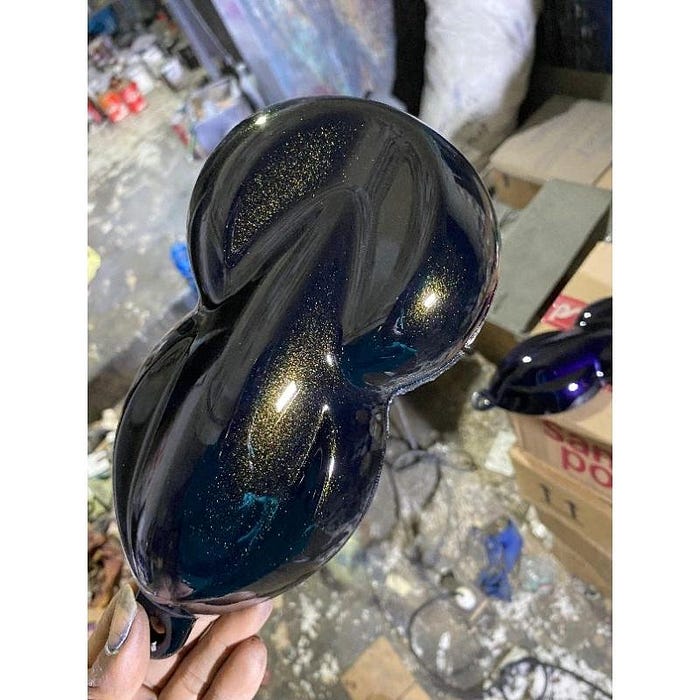
Cat Moonblack gold PU

  Cat Moonblack gold PU  adalah salah satu series yang mengandung partikel kecil seperti crystal yang dan memiliki effect lebih gelap sehing...